 Anna Sheronova

In short
The gym member retention strategies that work all happen before a member decides to leave: a plan for the first 90 days, a personal message when someone stops coming, failed payments chased within days, and a person who answers every cancel request.
- The benchmark: The average gym keeps 66.4% of its members a year, about two in three.
- Start with your numbers: Work out your own rate first, then fix the point where your gym loses the most members.
Most members do not leave on the day they cancel. They leave weeks earlier, when they stop coming, when a card fails, or when nobody noticed their first month went badly.
Start with the numbers, so you know which section is yours.
Which retention numbers should a gym track?
Four numbers tell you where your gym loses members. Count them the same way every month.
- Annual retention: the members you had 12 months ago who are still members today, divided by the members you had then. Leave frozen members out.
- Monthly churn: members who left this month, divided by members at the start of the month. Never multiply it by 12: at 3% a month you keep about 69 in 100 over a year, not 64.
- The 90-day share: of the people who joined three months ago, how many still come in. It shows whether your first weeks work.
- The cost of a lost member: the monthly fee times the months a member stays, which is roughly one divided by your monthly churn.
The average gym keeps 66.4% of its members a year, according to the HFA 2025 benchmarking report. What counts as good for your type of gym is on the gym retention benchmarks page. Type two numbers here and see your own rate and what leavers cost you:
Example: 1,000 members
- Retention66%
- Cost€120,100
- Stops at1,030
- First fix+35 members
- Playbook8 pages
Then pick where to start:
| What shows it | Start with | |
|---|---|---|
| New members leave in the first months | A low 90-day share | The first 90 days |
| Members pay but do not come | Many members with no visit in 30 days | Members who stop coming |
| Cancellations nobody asked for | Failed payments mixed in with cancellations | Failed payments |
| Members on packs drift away | Packs that run out with no next one | Class packs to monthly |
| Everyone says it is the price | Cost as the top reason on the cancel form | Why members leave |
What to do in a new member's first 90 days
New members leave first. In IHRSA's One Million Strong study, 67.2% of new members were still members 12 months after joining, so about one in three had gone within the year.
What keeps them is coming in. In retention data from UK gyms, members in their first six months who came in at least once a month were 27% less likely to cancel in the following month. So the first 90 days are about getting the second, fifth and tenth visit.
- Day 1: a welcome from a named person, who asks what they want to work on and when they like to train.
- End of week 1: check they have been in at all. If not, a coach messages them.
- Weeks 2 to 3: ask what is in the way. Time, nerves and not knowing what to do are the usual answers.
- Month 1: get them into one class or one small group, so somebody would notice if they stopped coming.
- Day 90: a short review with a coach, and a plan for the next three months.
The welcome and the end-of-week-one check can send by themselves. The hello at the first visit, the class introduction and the day-90 review need a person.
Number to watch: the 90-day share of each month's joiners.
What to do when a member stops coming
Contact a member who has gone quiet while they are still paying. In a study of three US clubs, monthly members waited 2.31 months on average between their last visit and cancelling. Some never start: 19.5% of members who cancelled at two European chains had not come in once in 24 months.
Every Monday, list members with no visit in 30 days, new members with no visit in their first week, and regulars whose visits dropped sharply. Send each a short personal WhatsApp message from someone they know, with a question rather than an offer, one more a week later if there is no reply, and then a call or a word at the desk.
The list is the part that slips in a busy week. Our WhatsApp automations can build it from your booking system and send or prepare the messages with the steps you choose, depending on which tools are connected. What to send and who sends it is in the guide on inactive gym members.
Number to watch: the share of the Monday list back within 14 days.
Chase failed payments within days
A failed payment is not a decision to leave, so count it apart from cancellations and act on it within days, not at the end of the month. Payment and software companies typically find that about one in five cancellations in subscription businesses is a failed payment.
Most of them are fixable. A card that failed once can be retried. An expired or cancelled card cannot, so the member needs a link where they can enter a new one, sent with a short personal message rather than a reminder from a no-reply address.
Number to watch: failed payments recovered within a week.
What to do when a member asks to cancel
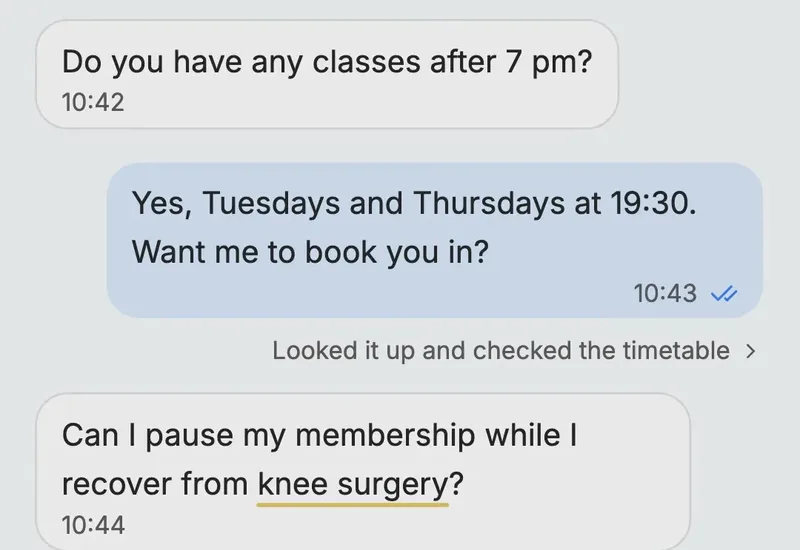
Reply to a cancel request within a day, from a person, and do what they asked. A member who asks to cancel has usually decided, and a hard time at the door is what they remember and tell others.
Ask one question: what made them decide. A failed card goes back to the payments step. Time, money or a move may fit a pause or a smaller plan. Offer a freeze with an end date, or fewer visits a month, once. If they still want to leave, cancel it and say goodbye properly.
Hi Lisa, thanks for letting me know, I'll sort the cancellation for you. Can I ask what made you decide? If it's time or money, a pause until [date] or a plan with fewer visits is also an option. Either way, just tell me and it's done.
If an AI agent answers your messages, it should pass cancellations and freezes to a person rather than process them.
Number to watch: cancel requests that end in a freeze or a smaller plan, and how many of those members are still coming 60 days later.
Move class-pack buyers to a monthly membership when it is cheaper for them
Offer monthly to a client who has two or three pack classes left and takes more classes a month than the monthly fee would buy in pack classes.
You can check it without prices. Count how many pack classes the monthly fee buys, then compare with the classes they would take in a month (4.3 a month at once a week, 8.7 at twice, 13 at three times).
| Once a week | Twice a week | Three times | |
|---|---|---|---|
| Monthly costs 6 pack classes | Pack is cheaper | Monthly is cheaper | Monthly is cheaper |
| Monthly costs 8 pack classes | Pack is cheaper | Monthly is cheaper | Monthly is cheaper |
| Monthly costs 10 pack classes | Pack is cheaper | Pack is cheaper | Monthly is cheaper |
| Monthly costs 12 pack classes | Pack is cheaper | Pack is cheaper | Monthly is cheaper |
Do not push monthly on someone who comes once a week. In the same study of three US clubs, members on a flat monthly fee came about four times a month and paid more than $17 a visit when a 10-visit pass would have cost $10 a visit. A member who works that out later leaves annoyed.
Number to watch: pack clients still on monthly 60 days after the offer.
Do early renewal and prepay discounts keep members?
Mostly not. They bring cash forward from members who would have renewed anyway, and help retention only when they lengthen a commitment for a member who already comes regularly.
Paying up front changes how people come in. John Gourville, who studied health club members, found that members are more likely to go right after a payment than later on, and that members who keep coming regularly are more likely to renew. A big prepaid year can fade from memory, and attendance with it.
So offer early renewal to regulars, never as a rescue for someone who stopped coming. To know whether it works, offer it to half of the eligible members and compare how many in each half renew a year later.
Number to watch: renewal a year later, against members who had no offer.
Ask why members leave, and sort the answers
Ask every leaver why, and sort the answer, because the cancel form is a poor witness. Four groups cover almost everyone:
- The card failed. Nobody decided anything; this belongs to the payments step.
- No reason given. No conversation, often a member who had stopped coming.
- A short reason. "Cost" or "no time", which usually means attendance had already dropped.
- A real reason. A move, an injury, a change of job.
If most of your leavers sit in the first three, the fix is earlier in the year, not at the cancel request.
Number to watch: the share of leavers with a reason recorded.
Win back members who left, at the right moment
The message that brings a former member back fits the reason they left. Someone who moved away gets nothing. Someone who left over their work hours hears when a class at a new time opens.
Time it to moments when people restart: January, September, the end of the summer holidays, or their old class coming back to the timetable. One gym software company reports that a well-timed campaign brings back 1 to 5% of former members, so expect a small gain.
Leave out anyone who asked not to be contacted.
Number to watch: rejoins per message, and how many of them are still members 90 days later.
Which retention tools does a gym need?
A gym needs fewer retention tools than the software lists suggest. Most of these jobs can be done by hand at a small gym; a tool pays when the list is too long to keep up with.
| The job | When it pays | |
|---|---|---|
| Billing with automatic retries | Retries failed cards and sends a card update link | From the first member |
| Attendance alerts | Lists members with no visit in 30 days or a sharp drop | From about 100 membersbelow that you see it by eye |
| Messages that react to events | Sends a welcome, a check-in or a follow-up when something happens in your booking system | Once nobody has time to send them every week |
| Cancellation reasons | Records why each member left, in your four groups | From the first leaver |
| Class and group booking | Gets new members into a class with the same people each week | From the start, if you run classes |
| Reporting | Retention, churn and the 90-day share, month by month | From a few hundred members, or a second location |
What stays with people: the hello by name, the coaching conversation, the introduction to another member, and the reply to someone who wants to leave.
Questions people also ask
What is a good gym member retention rate?
Above 66.4% a year, the average in the HFA 2025 benchmarking report. Compare a full year of your own numbers with it, never one month. The benchmarks page gives a fair target for each type of gym.
When do most gym members cancel?
In their first year, and often months after they stopped coming. In IHRSA's One Million Strong study, 67.2% of new members were still members after 12 months, so about one in three had left.
Why do members quit the gym?
They usually say cost or time, but many had already stopped coming by then. Paying for something you no longer use feels expensive at any price, which is why a message in the first weeks of silence usually helps more than a discount at the cancel request.
How do I move class-pack clients to a monthly membership?
Offer it when a client has two or three classes left and takes more classes a month than the monthly fee buys in pack classes, because then monthly is cheaper per class for them. Do not push it on someone who comes once a week: for them the pack is the better deal.
Do early renewal discounts improve retention?
Rarely. Mostly they bring cash forward from members who would have renewed anyway. They help retention only when they lengthen a commitment for a member who already comes regularly. Judge one by how many of those members renew a year later, not by the cash it brings in.
What does losing a gym member cost?
The monthly fee times the months that member would have stayed. A simple way to estimate the stay is one divided by your monthly churn: at 4% a month, about 25 months. The retention calculator does the sum for your gym.