 Anna Sheronova
The short answer
For what an AI chatbot can and can’t do at a gym, and where it can sit (your website, WhatsApp or phone line), start with the guide to AI chatbots for gyms.
Lisa messages your gym at 22:40 to ask if there’s a spot in Thursday’s 19:00 class.
An AI agent reads the timetable, answers Lisa and books her in. An AI assistant waits for your team. In the morning it shows your front desk the free spots and a suggested reply, and a person sends it.
Both work in the WhatsApp and website chat your gym already uses, and you can run both.
What’s the difference between an AI agent and an AI assistant?
An AI agent sends the message to the member itself. With an AI assistant, a person on your team sends it. The assistant also looks things up for your staff, but nothing reaches a member until one of them presses send.
| AI agent (receptionist) | AI assistant for your team | |
|---|---|---|
| Who sends the message | The AI, in your gym’s chat | A person on your team |
| What members see | A reply that says it’s from an AI | A reply from your staff |
| Telling members it’s AI | Needed from the first message | Not needed when staff read and send |
| Hours covered | Any hour, nights and weekends too | The hours someone is working |
| What the team still does | The handed over conversations, and the desk itself | Every conversation, with less typing and looking up |
| Best for | Routine questions and after hours | Sales, complaints and anything personal |
What an AI agent does at a gym
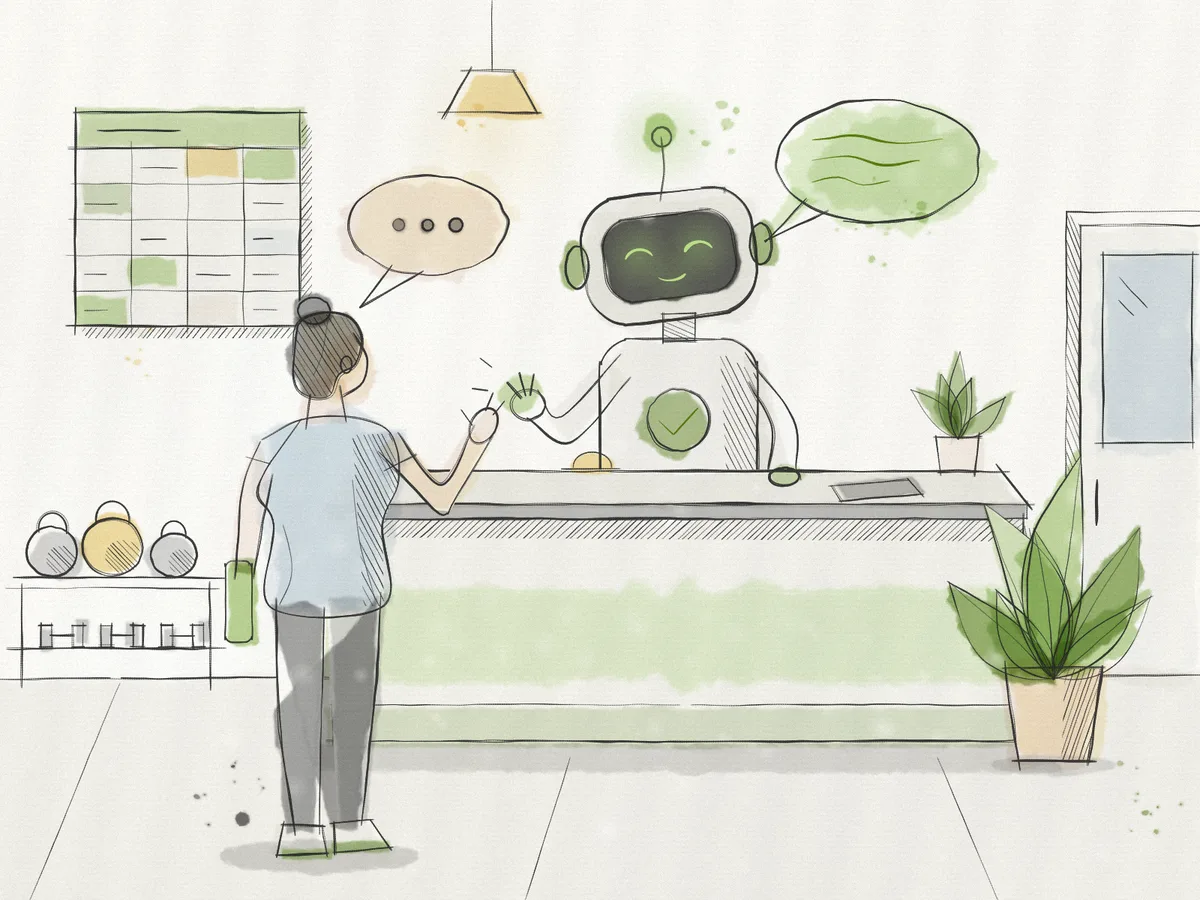
At a gym, an AI agent answers members and leads on its own from your timetable, prices and policies, and books or moves a class when a member asks. It checks the booking system before it answers.
You set the rules for what goes to a person, such as a refund, a membership pause, an injury or a complaint. When a member asks for a person, your team gets the whole conversation, so the member doesn’t have to repeat it.
At one boutique studio in the Netherlands we work with, 4 of the 110 people in 152 WhatsApp conversations asked to talk to a person. The studio’s own rules sent more conversations to the team than that.
Give it the questions with one answer in your timetable or price list, and the hours nobody is at the desk.
Routine and after hoursWhat an AI assistant does for your front desk team
An AI assistant suggests replies and looks up facts for your staff, and a person on your team sends every message. Your front desk writes to members the way it does now. In the background the AI drafts replies, checks the booking system for a free spot, sums up a long thread before someone picks it up, and translates a message from a member who writes in another language. Your staff change what they want and send it.
In a 2025 study in the Quarterly Journal of Economics, 5,172 customer support agents got an AI tool that suggested replies, and they still sent every message themselves. They resolved 15% more issues per hour on average, and the less experienced agents gained the most. Customers asked to speak to a manager less often. For the most experienced agents, speed barely changed and quality dipped slightly.
Those were agents at a large support company. At a gym, a new or part-time person on the desk gets the most from it. If you already write the best replies yourself, it mostly saves you looking things up and typing.
Regymo offers this setup as the AI receptionist for your team.
Staff send every messageDo members have to know it’s AI?
In the EU, an AI agent has to tell members it’s an AI, at the latest in its first message. An AI assistant doesn’t, as long as your staff review each reply and send it themselves.
That line comes from the European Commission’s guidelines on Article 50 of the EU AI Act, published in July 2026. The duty to tell people they are dealing with an AI covers systems that talk with people directly. The guidelines name customer service staff who use AI tools to help them write as an example of what falls outside it. Clicking send on whatever the AI wrote does not count.
A line in your terms and conditions doesn’t count, and neither does calling it just an “assistant”. The agent has to say it in the first message, as in the chat above, and again whenever a member asks.
The agent must say soIs an AI agent just a chatbot?
No. An AI agent chats like a chatbot, and it can also act on what the member asks, such as booking or moving a class. A classic chatbot answers from a script or a list of questions and answers, and stops there.
To tell them apart, send it a message that needs something done, such as “can you move my Thursday class to Friday?”. A chatbot sends a link or tells the member to call. An agent checks Friday, moves the booking and confirms it.
The second test is what it does when it doesn’t know. A good agent says so and hands over. If it guesses a price, the member gets a wrong answer from your gym. For more on what puts members off, read why gym members hate chatbots.
Not if it can actWhich is right for your gym, and can you use both?
- You coach and answer messages yourself. Messages wait until after class, and leads go cold in the evening. An AI agent fits. It answers and books at any hour, and hands you the rest.
- You have front desk staff, and members expect a personal reply. Staff look up the same class times and prices all day. An AI assistant fits. It drafts the reply from your booking system, and your staff send it.
- Someone is at the desk in the day, but nobody in the evenings and at weekends. Use both. The agent takes evenings and weekends, and the assistant helps your staff in the day.
Anything personal, like an injury, a complaint or a member’s progress, goes to a person either way.
Telling people they are talking to an AI can cost sales. In a 2019 field experiment in Marketing Science, a sales chatbot that said it was a bot at the start of the call sold about 80% less than the same chatbot when it didn’t. The calls went to more than 6,200 customers of a lending company, about renewing a loan. That was a phone sales call, not a gym chat, and in the EU the agent has to say it’s an AI anyway. It is still a good reason to have a person talk price and sign up new members.
Ask it what your members ask
Send it a question your front desk gets every week and see whether it answers, books or hands over.
Is there still a spot in Thursday’s 19:00 class?Test it
If you’re weighing an AI agent against hiring someone for the desk, that comparison is AI receptionist vs front desk staff.
Who answers, and whenQuestions people also ask
Do I have to tell members if AI helped write a message?
Not when a person on your team reads the message, changes what they want and sends it. The European Commission’s guidelines on Article 50 of the EU AI Act (July 2026) put staff who use AI tools to help them write outside the duty to disclose, as long as a person reviews and sends each one. An AI that replies to members on its own has to say it’s an AI. This is a heads-up, not legal advice.
Can the AI assistant see our booking system?
Yes, once it’s connected. It checks the same timetable and bookings your front desk sees, so a suggested reply can say whether Thursday’s class still has a spot. Your staff decide what gets sent.
Does approving every AI reply make it safer?
Not reliably. In a 2024 PLOS One study, an online experiment on predicting students’ test scores, people who could adjust an algorithm’s recommendations made slightly less accurate decisions than people who let it decide, and they stepped in less often on its biggest errors. What helps more is an AI that answers from your timetable, prices and policies, and hands over when it can’t find the answer.
Can we give the AI agent a name?
Yes, as long as its first message says it’s an AI. The European Commission’s 2026 guidelines on Article 50 of the EU AI Act say that calling it only an “assistant”, or giving it a human persona that could mislead, doesn’t count as telling people.