 Alex Mykhalevych
In short
An AI chatbot for a gym answers questions and handles bookings at any hour on your website, WhatsApp or phone, but the personal conversations a member has with you belong to a person.
- What the chatbot knows: It answers from what you give it: website, prices, timetable, policies.
- What it can do for a member: Connected to your booking system, the chatbot takes action for the member, not only answers: booking, rescheduling, trials, passes and more.
- Where it hands over: You decide what it hands to a person, for example progress, achievements or medical issues.
Where can a gym put an AI chatbot? Website, WhatsApp or phone
A gym can put an AI chatbot on its website, in WhatsApp or on its phone line. It is not one thing you buy. It is a way of answering that you can put where your enquiries actually arrive: the website visitor pricing a trial at 22:00, the member moving a class on WhatsApp, the call that rings out during the 19:00 session. Same questions, three doors.
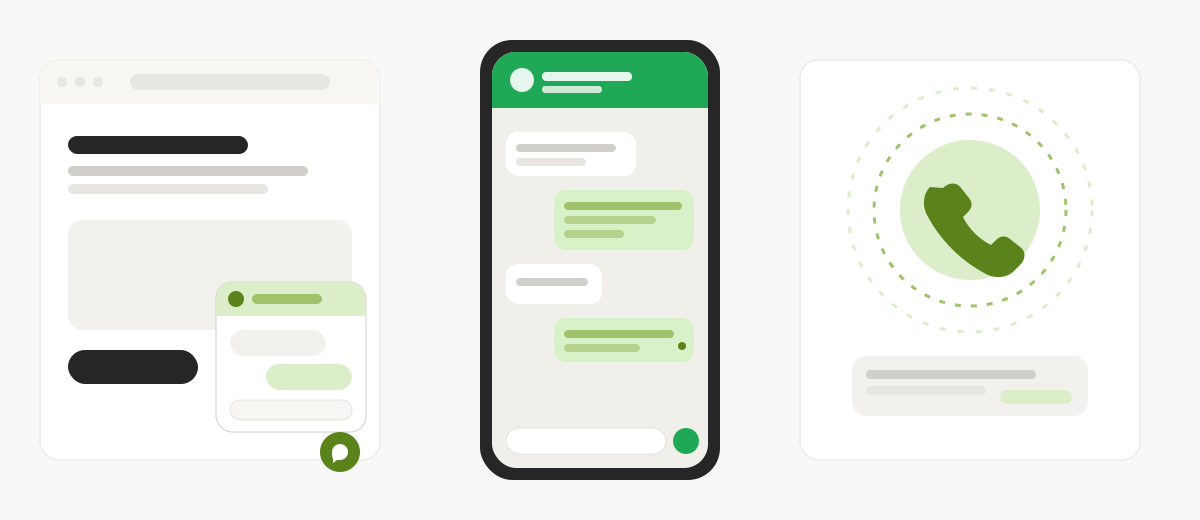
| Website chat | Phone line | ||
|---|---|---|---|
| Who writes | A visitor before signing up | Leads and members | Callers |
| Best at | Answering after hours, before the lead moves on | Booking trials, follow-up, and members’ bookings, credits and freezes | Missed calls and short questions like opening hours |
| Weak at | Existing members, who rarely go back to the website | Website visitors: they have to tap your WhatsApp icon and write there, one step more than a chat on the page | Anything that needs a long back and forth |
| Start here if | Leads go unanswered overnight | People already message you on WhatsApp | Calls ring out to voicemail |
Which door matters most is the whole decision, and the three sections below take them one at a time. If you tried a chatbot around 2019 and found it awful, that instinct was right then: those were rigid decision trees with dead ends. Tools that answer from your own documents behave differently, and what members feel on the other end is covered in why gym members hate chatbots.
What an AI chatbot does on your gym website
An AI chatbot on your website talks to a visitor who has found you and has a question before signing up: prices, the trial offer, the timetable, which class suits a beginner. Where it sits on the page is up to you and how your site is built. The bubble in the corner is the common choice; a chat input in the middle of the landing page, inviting the question, is another.
Either way it is strongest after hours, when the visitor comparing three gyms at 22:00 gets an answer instead of a form somebody reads tomorrow, and weakest at serving existing members, who rarely return to the website once they have joined. They are in WhatsApp. So treat it as a way to catch new leads. If enquiries sit unanswered overnight, this is a reasonable first door.
It only earns its place if strangers actually land there. If your website is mostly a timetable your members check, a chatbot on it will be quiet. Before it hands a question over, it should ask how to reach the visitor, a phone number or an email, because once they close the tab the conversation is gone.
An AI chatbot on your gym’s WhatsApp: auto-replies and bookings
On WhatsApp, an AI chatbot replies automatically from the number your gym already uses, and it is for leads as much as for members. A lead reaches it through the WhatsApp button on your website, the link in your Instagram bio, or by messaging the number directly, and gets the same instant answer, plus the one offer that matters: a trial slot to book right now.
Because the number is already in the thread, the follow-up lives there too: the reminder the day before the trial, the message after it, the nudge when someone goes quiet. Members get the routine work in the same place: booking and moving classes, credits and freezes, membership questions. Wherever people already message the gym on WhatsApp, this is the higher-impact door. The reminder and the nudge are messages your gym starts, and WhatsApp charges businesses for some of those per message. Ask any provider whether those fees are in the price or billed on top.
Whether it answers members on its own or helps your team answer them is a separate decision, and a real one: see AI agent vs AI assistant.
What an AI chatbot does on your gym’s phone line
AI on your phone line answers inbound calls, handles the routine ones and texts back the callers it cannot finish. The job is the missed call: after hours, during a class when nobody is at the desk, the second caller while you are mid-conversation with a member in front of you.
It earns its place where calls are genuinely lost, and it is poor at anything that needs a long exchange. Voice copes with opening hours and booking a tour; a multi-step conversation belongs in a text thread. For most single-site gyms the phone is not the main door, so this is rarely the first one to buy. Whether the answer is a machine or a part-time hire is weighed in AI receptionist vs a human front desk.
What can an AI chatbot actually do for a gym?
A gym chatbot answers questions automatically and, connected to your booking system, handles bookings too. It works at two levels, and the first needs no integration at all. Given what you already have, your website, your prices and timetable, your policies, anything else you want it to know, it answers the routine questions in seconds at any hour, qualifies a new enquiry, and points people to where they book. Connected to your booking or membership system, it also does the admin: books a trial or a session, moves or cancels a class, tells a member how many credits are left and when the membership renews, confirms and reminds, which helps against no-shows. Either way, the answers are only as good as what it was given, which is why "answers from your real information" is the first thing to check.
Speed is the part that is hardest to argue with. In 2011, Harvard Business Review reported on 1.25 million online sales leads: companies that tried to reach a lead within an hour were nearly seven times as likely to qualify it as those that tried even an hour later, and more than 60 times as likely as those that waited a day or more. No small team hits that window at 21:47 on a Saturday.
Reply within the hour and you are nearly seven times as likely to qualify the lead as a company that replies an hour later. Wait a day, and the gap is more than 60 times. Harvard Business Review, 2011, on 1.25 million online sales leads.
Read the study →The honest case is not that a chatbot wins you more members. It is that the enquiries arriving when nobody can answer are currently worth nothing, and a first reply inside five minutes is something a tool can do and a person cannot.
The number the whole decision turns on is your average time to reply, and especially what it becomes outside staffed hours. It is rarely zero even during opening hours: the person who would answer is coaching the 19:00 class, or standing with a member at the desk. Your call log and message timestamps already hold that number. What gets answered automatically, what waits for you, and where the handover sits are set out in our AI agent for gyms overview.
What should an AI chatbot not handle?
A gym chatbot should not handle personal conversations; those belong to a person. It is the right place for the routine and the transactional, whoever is writing: a lead asking how a trial works, a member moving a class or checking credits. Both usually prefer the instant answer. But a member who messages to share a personal best, or that they are back after a knee operation, or how a hard month went, is writing to you, not to the front desk. An automated reply there, however polite, is the thing owners mean when they say members hate chatbots.
The same goes for a medical issue, a complaint, or anything where the person needs to feel heard rather than answered. None of that is beyond a chatbot to recognise; it is beyond it to answer well. So the setup, not the tool, decides: the chatbot keeps the routine, and hands the personal to a person, with the thread attached.
Where setups break in practice:
- Facts it was never given: prices, class times, instructor names. Have it answer only from your own documents and give it a way to say it doesn’t know
- Being cornered: when it doesn’t know, it must say so and hand over. A bot that loops is worse than no bot
- Answering what it should have handed over: a member’s progress, a medical note, a complaint. Those need a routing rule, not a better answer
- Handover gaps: if it says it will fetch staff at 23:00 and nobody appears until Monday, you have built something worse than silence
A setup that recognises the personal conversation and steps aside is working as intended, not falling short. The objections owners raise before buying are worked through one by one in the eight questions owners ask.
What does an AI chatbot need to work properly?
A gym chatbot works properly only when it has the information a good front desk has. It needs all of it in the end; it does not need all of it on day one. What it needs:
- Your prices, timetable and trial terms, and the policies on cancellation, freezing and data. A tool built for gyms reads most of this from your website to begin with
- How your front desk talks: the words you use, the things you would never say, how you handle someone who is annoyed
- A connection to your booking system, if you want it to book, so it reads real availability and writes a real booking
- A handover rule: when it does not know, it says so and passes the thread to a person, on a channel somebody actually watches
- An opening line that says it is an AI
The way to get there is step by step. Start with what already exists, let it answer, and fill the gaps as they appear: each time it meets a question it cannot answer and hands over, your staff add the answer in one step, and the next person gets it right away. A tool that makes that easy is set up in weeks of normal work, not in a project before launch.
That last one stopped being only good manners. From 2 August 2026, Article 50 of the EU AI Act requires an AI system that interacts directly with people to make clear it is an AI, unless that is already obvious. In practice: one sentence at the start of the conversation, plus a real route to a human. A heads-up for owners, not legal advice. The build itself, and where doing it yourself stops paying, are in how to set up a gym chatbot.
How to choose which channel to start with
Start with the channel where most of your enquiries arrive and wait longest for a reply. Where do they actually arrive: the website form, WhatsApp, or the phone? How long do they wait for a reply, and how much longer when nobody can pick up? And how many of them are the same three questions about price, timetable and trials?
If most arrive on WhatsApp, start there. If they arrive through the website and sit unanswered overnight, start with the widget. If they ring and get voicemail, start with the phone.
One last question, because it decides whether any of this works: when the chatbot meets a question it cannot answer, how quickly does the right answer get in, and who adds it? A tool that makes that a one-step habit for your staff gets better every week; one that makes it a project stays exactly as good as the day it was installed.
Questions people also ask
Do I need an AI chatbot on WhatsApp, on my website, or both?
Start where your enquiries already are. If your members and leads already message you on WhatsApp, it is worth adding an AI there that answers the repeated questions which do not need a person, because that is where the volume and the phone numbers already sit. If you are not on WhatsApp yet and your audience does not live there, start with the AI on your website, where visitors find you first. Plenty of gyms end up with both.
Can an AI chatbot book trials and classes, and cancel them?
Yes, once it is connected to your booking system: it can do what your front desk does there, such as booking a member in, moving a session, cancelling or giving back a credit. How far it goes depends on what your booking system allows and on your own rules. You decide which actions it takes itself and which it hands to a person.
How do I stop my gym’s AI chatbot making something up?
Have it answer only from your own timetable, prices and policies, so it never has to guess. Give it an explicit fallback so it says it does not know and fetches a person instead of improvising. Connect it to your booking system so it reads real availability rather than inventing a slot. Any vendor answering this with an accuracy percentage is selling, not answering.
What does the EU AI Act mean for my gym’s AI chatbot?
From 2 August 2026, Article 50 of the EU AI Act requires an AI system that interacts directly with people to make clear that it is an AI, unless that is already obvious to a reasonably observant person. For a gym that means one honest opening line and a working route to a human. This is a factual heads-up for operators, not legal advice.
Does an AI chatbot mean replacing my booking system?
No. Most gyms keep the booking or membership system they already run and add an AI chatbot on top of it, connected well enough to read the real timetable and write a real booking. Replacing your main system is a much bigger project than adding an AI chatbot, and the two decisions are separate.