 Anna Sheronova

In short
To reduce gym no-shows, ask people to confirm they are coming the day before the session.
- Why they skip: Plans change, and missing a free booking costs them nothing.
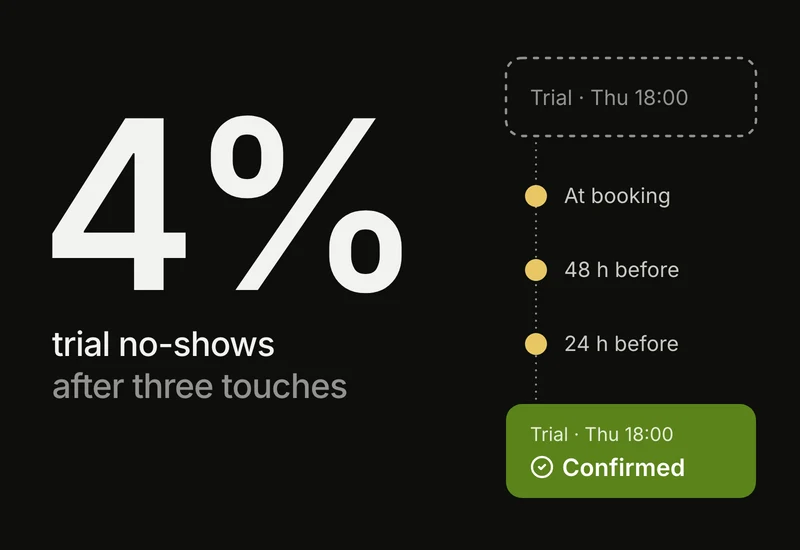
- The three touches: Confirm at booking, warm them up, and ask for a yes 24 hours before.
- Classes vs trials: Keep the three touches for intros where a trainer’s hour is held.
Lisa Jansen books a trial on Sunday 8 November at 19:05 for Thursday 12 November at 18:00 with the coach Sanne. By Thursday morning, she has forgotten all about it. This applies to any place that holds a spot for one person, from a pilates or yoga studio to a boxing club or personal training studio. This guide starts at the moment of booking. If your leads drop off before they schedule a visit, read our guide on follow-up for leads who never booked.
Why people skip, and the perishable hour
To reduce gym class no-shows, look at what happens between the booking and the session. People schedule a trial when their motivation is high. By Thursday morning, Lisa has been to work, her week has filled up, and the trial is the last thing on her mind. Plans change, and to a new lead, the studio is not yet a business. To them, missing a free booking costs nothing and hurts nobody.
For the studio, the hour is perishable. A trial takes a trainer’s time, and the spot held for Lisa cannot go to anyone else. If she skips, you pay your coach for the hour anyway. Writing on capacity management, Kimes's 1989 paper in the Journal of Operations Management explained the principle: an unsold airline seat cannot be sold after departure. The same logic applies to any firm with fixed capacity. Once the hour has passed, it cannot be sold again.
Ask for a yes, not a promise
You cannot force anyone to attend a session. You can, however, make them tell you whether they are coming. An active confirmation handles two groups at once. People who would have forgotten are reminded and turn up. People who will not come say so instead of skipping silently, which means the spot can go to someone else on the waitlist.
Studies of health-care appointments show that making the cost of a missed slot visible changes behaviour. A 2015 trial at a London NHS trust published in PLOS ONE and a 2020 large field test in Israel also in PLOS ONE both found that telling people what a missed appointment costs cut no-shows. Both studies also found that advance cancellations rose. For a studio, an advance cancellation is a good outcome, because a cancelled slot can be resold and a silent no-show cannot.
Writing down a specific plan also helps people commit. A 2011 PNAS field test of 3,272 employees found that prompting people to write down the exact date and time of their planned flu shot raised vaccination rates, especially when there was only one chance to attend.
What sales teams do about skipped meetings
A booked trial is the same situation as a booked sales meeting, so it makes sense to look at what sales teams do. Someone who owes you nothing has agreed to a time, and the slot is lost if they do not turn up. In sales, this problem is sharpest because a missed meeting is a missed sale. It is a well-funded field where people have spent years working out how to get someone to show up, so it is worth borrowing the routine they settled on.
Sales teams treat skipped meetings as a problem with a settled fix. Representatives usually confirm at once, warm the person up and ask for a confirmation the day before. They do this because a prospect who agrees to a meeting often forgets it the minute they hang up the phone.
This routine fits a studio trial, because a coach’s hour is held for one person the same way as a representative’s calendar slot. Sending three distinct messages builds the relationship before they arrive, so you do not have to hope they remember.
Research on notifications in health care supports this cadence. A 2016 BMJ Open meta-analysis of digital notifications for clinical appointments found that text notifications reduced no-shows, and that multiple notifications did better than single ones.
The three touches before a trial
At booking. Confirm the session immediately so the person has a record on their phone. Spell out the day, the date and the exact time, and state your cancellation rule here so nobody is surprised later.
A couple of days before. Send a warm-up message to lower the threshold of walking into a new place. Tell Lisa what to expect, remind her to bring water and a towel, and add a brief note saying Sanne is looking forward to meeting her.
24 hours before. Ask her to confirm. On WhatsApp, once the conversation has started in their main messaging app, people rarely ignore a direct question about their attendance.
Regymo sets up these WhatsApp automations with your studio. They send the touches on WhatsApp from your bookings, stop when someone cancels or replies, and the no-show follow-up waits for your team’s OK.
If you are building this routine, read our guide on WhatsApp Business for gyms to understand the rules for automated messages. You can also read about how automated messages feel to members.
When they go quiet the day before
When someone actively confirms their booking, they almost always show up, while the people who skip are usually the ones who never replied. A fitness franchise in the Netherlands cut trial no-shows to 4% over the period of 22 December 2025 to 15 October 2026, and the head of the franchise observed that in practice everyone who replied with a yes came to the session.
If Lisa had not replied by Wednesday evening, that silence is a useful piece of information early enough to act on. Instead of waiting to see an empty room on Thursday, your team can send a short message from Sanne asking if another day works better. If that gets no answer, you can free the spot for someone on the waitlist. That early warning is the main benefit of asking for a confirmation.
Classes vs trials: when three touches are too many
Keep the three touches for sessions where an empty room costs you a place. For a member’s regular class booking, three messages is too many.
| Trials and intros | Regular classes | |
|---|---|---|
| Who it is for | New leads and one-to-one clients | Existing members |
| What is at stake | An hour held for one person | One spot in a group |
| What to send | Three touches, ending in a request to confirm | One reminder the day before |
| How to handle a miss | Follow up to rebook | Apply the late-cancel rule |
If you want to cut regular class no-shows, a regular booking needs one reminder asking for a reply, a clear late-cancel window and a waitlist that gets the freed spot. A member who trains three times a week will ignore repeated warm-up messages, but a single prompt the day before keeps the timetable accurate.
No-show fees and cancellation windows
A no-show fee or a strict cancellation window does not make anyone turn up, nor does it make them tell you they are skipping. What it does is set a rule people can plan around, and it acts as a backstop after the confirmation request. If you use fees or strict windows, a few principles keep them fair and effective.
State the rule at booking. Mention the cancellation policy in the very first touch so nobody is surprised later.
Choose a cancellation window based on how quickly a freed spot can be filled. If your waitlist moves fast, a four-hour window might be enough. If you need a full day to fill a spot, set a 24-hour rule.
A fee is fair only when cancelling takes one simple message. If a member has to log into a portal or call during specific hours to cancel, the fee feels like a trap. Once you have sent an appointment reminder text the day before and asked for a yes, charging a fee when someone skips silently is reasonable. Even then, many studios forgive a first offence, because a genuine emergency or an honest mistake happens to everyone.
What to send after a missed session
If Lisa had missed her trial on Thursday, the first step is a friendly note asking if everything is alright and offering her a chance to pick a new time, because a first miss is usually just a slip. If she misses a second time, the message should be more direct. By the third miss, a member has formed a habit that hurts the studio, so they receive a clear reminder of your booking rules. In Regymo, your team approves each of these messages before it goes out.
For more on what to do after the trial when the lead does attend, read our guide on turning trials into members.
Questions people also ask
How do you reduce no-shows at a gym?
Send three touches before a trial or intro session. Confirm the booking immediately, send a warm-up message a couple of days before, and ask for an active confirmation 24 hours before the session.
Should a gym charge a no-show fee?
A no-show fee works best when people have already been asked to confirm their attendance. It sets a clear boundary, but it should be paired with an easy way for members to cancel or move their booking in advance.
How far in advance should you send a class reminder?
For a regular class, one reminder the day before is enough. For a trial or a one-to-one session where a trainer’s hour is held, ask for a confirmation 24 hours in advance.
What do you say in a message to someone who missed a trial?
Send a friendly note the first time asking if they want to pick a new time. If they miss a second time, be more direct, and on the third miss, send a clear reminder of your booking rules.
Does this work for a pilates or yoga studio?
Yes. A spot in a small pilates class or a one-to-one hour is exactly the same perishable slot. The three touches matter even more where groups are small.