 Anna Sheronova

In short
Most people who quit a gym do it in the first months, so new member onboarding decides a lot. You cannot spend an hour with every new member, and most do not need it.
- The problem: Many new members leave because they lack a routine or feel unsure what to do.
- The fix: Ask everyone a short question at set moments, automatically.
- The human part: Your team spends time only on the people who answer with a struggle.
Lisa joins a gym on Monday 2 November 2026 and does her first training on Wednesday 4 November with the coach Sanne. By the second week she has not been back, and nobody at the gym has noticed yet.
To understand the wider picture of keeping members, read our guide to gym member retention. Before onboarding even starts, the challenge is often turning trials into members. This page covers the onboarding process once they join.
Most People Who Quit Do It in the First Weeks
A large share of new members stop within the first months, which means your new member onboarding process has a lot to do with whether they stay. In a study of 5,240 members of a fitness centre in Rio de Janeiro, Sperandei, Vieira and Reis (2016) found that 63% had stopped before their third month. Gjestvang and colleagues (2020) tracked new members in Norway and saw 20% drop out by month three, and 28% by month twelve.
Many owners see this drop in their own numbers. The owner of a gym in the Netherlands saw in his data that they were losing many people during the onboarding, not as members but in the appointments themselves. When a person cancels, they usually cite a change in their schedule. He noted that this hides the actual problem:
Many people cancel and say they have other priorities, or no time. That's not the real reason. … Somewhere in the process they struggled, but we didn't check in at the right time, so they didn't get the help they needed.
The Two Struggles They Rarely Mention
Regymo measured it at one gym in the Netherlands in early 2026, among members who replied to a check-in and said what they struggled with. About half named staying consistent and accountable, and 31% named a gap in knowledge, meaning they did not know what to do or how to train. You can read the full breakdown in how we measured it.
Both hurdles take time to overcome. Kaushal and Rhodes (2015) found that new gym members needed to attend at least four sessions a week for six weeks before exercise became a habit. A new member who visits once a week is still a long way from a routine by month two. They plan to train on Tuesday, but work runs late, and because they have no routine yet, missing that one day easily turns into missing the whole week.
Some people overestimate themselves. I think I'm going to the gym. I don't need a lot of help. I'm quite confident that I can go to the gym, that I know what to do and that I can train consistently. But we as coaches might think something different. You say that you can do everything by yourself. But the last two times that you went to a gym, you quit in three months.
Confidence matters just as much. Williams and French (2011) showed that giving people clear instruction and an action plan went with more confidence and more activity. A new member who does not know how to set up the squat rack or adjust a machine is likely to feel awkward and leave early. They look around, do a few minutes on a treadmill, and go home.
They rarely tell you they are struggling. In that same measurement at the Dutch gym, 41% of the members mentioned something a coach could help with, and most did not ask. Attrition research on UK and Irish direct-debit members, reported in Health Club Management (2023), found that about half of leavers give no reason at all and quietly walk away.
Why the Team Misses the Signs
If the problem is confidence and routine, proactive help works. Someone who checks in catches the slip while it is small. The difficulty is doing it consistently.
Another owner in the Netherlands ran check-ins on days 7, 14, 30 and 90 by hand as a daily routine, with a separate action for each one. Doing it every week for every new member is hard. The more members join, the less of it gets done, because the team simply runs out of hours.
When onboarding depends on who works the desk, the rhythm breaks. Staff work different shifts. Nobody can see at a glance where a new member stands. One person does a thorough intake, and the next just asks what the member's goals are.
One instructor does a really deep dive in the first intake and gets a lot of information. Some instructors just ask what your goals are and how they can help. Everyone has to do the same thing.
The work falls between the cracks because no single person owns it from start to finish.
| Onboarding by hand | Written into the process | |
|---|---|---|
| Who remembers the next step | The coach, using memory or sticky notes | The system generates the task on the right day |
| What happens on a busy week | Check-ins are skipped | Messages go out by themselves |
| What the quality depends on | Which staff member is on shift | The rules you set for the whole gym |
| Where the coach's time goes | Checking who attended and writing routine texts | Talking to the people who actually need help |
Ask Everyone, Help the Few Who Need It
You cannot give every new member an hour of a coach's time every week. You do not have the hours, and many members are perfectly fine on their own.
Basch and colleagues (2016) gave patients on chemotherapy a weekly automated check-in to report their symptoms. Nurses received alerts only for severe or worsening problems. Emergency visits fell from 41% to 34%. Nobody has tested this exact setup in gyms, since this is health care, but a gym can borrow the pattern: ask everyone automatically, filter the answers, and escalate only the people who need a coach.
The check-ins have to keep going. A study of 61,293 members of a US gym chain by Milkman and colleagues (2021) found that 45% of 54 four-week programmes raised visits while they ran. Few had any effect once they stopped.
A sequence asks the question automatically. The people who are fine stay fine, and your team spends its time only on the ones who signal they need a person. If you are wondering where to draw the line between software and staff, our guide to what to automate at a gym maps it out.
The First 30 Days: What to Send and When
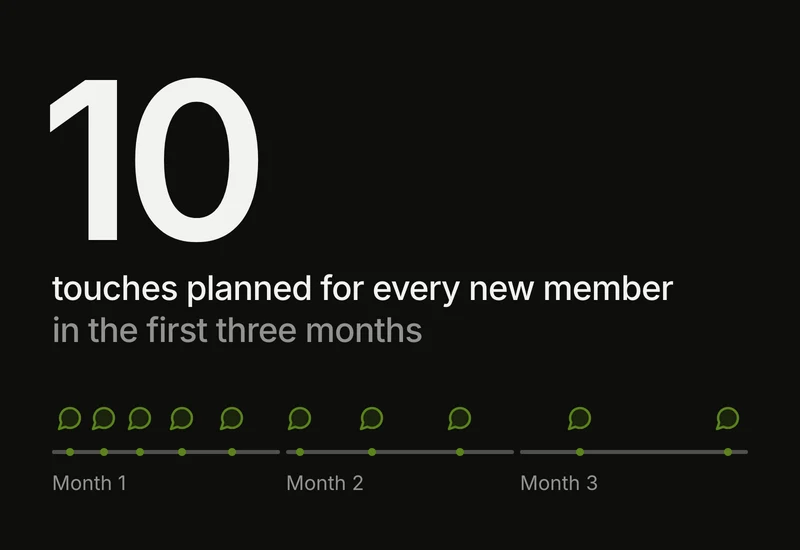
Here is a schedule for the first month that covers the gaps without overwhelming the desk.
- Day one welcome. When the membership starts, a greeting signed with a staff member's name waits for staff to approve it before it goes out. If they reply they are fine, nothing happens.
- Around the first training. A short message sends automatically the day before with the time and the trainer's name. Another sends automatically the morning after to ask how it went, and one more after the second session.
- Next session not booked. If seven days pass after the first training without a new booking, silence generates a task to plan the next session with them. This requires human action from your team.
- Days 7, 14 and 21. A check-in sends automatically every Sunday morning asking about the goals you agreed on at the intake. If they answer with a struggle, the coach gets the chat.
- Day 30. A wrap-up check-in sends automatically to see how the first month felt.
Regymo's WhatsApp automations run this process for you. We set the rules up together with the gym, and the messages go out on WhatsApp at the set moments. The platform reads the replies, hands the ones that need a person to your coach, and gives your staff a task when a next session is not booked.
What Changed at One Gym
We tracked the results at one gym in the Netherlands. We measured the automated welcome, the messages around the first trainings and the tasks for unbooked sessions over the first half year. The weekly check-ins are a newer addition and do not have numbers yet.
Of the people who started the onboarding, the owner's figure is that 88% became paying members. You can read the details in the onboarding case study.
If a member stops coming anyway, our guide to bringing inactive members back picks up where the onboarding leaves off.
Questions people also ask
How do you onboard a new gym member?
Give them a clear routine and check in regularly. A good onboarding plan asks how they are doing at set moments, reads their answers, and hands them to a person if they struggle.
What should a gym do in a new member's first 30 days?
Confirm their first training, see how it went, and follow up every week. Reach out proactively if they stop booking classes. Do not leave them to figure the schedule out alone.
Why do new gym members quit in the first few weeks?
They fail to build a habit, or they feel unsure what to do. Most leave quietly. New gym members in one study needed about six weeks of consistent visits before the routine sticks (Kaushal and Rhodes, 2015).
How soon should you contact a new member after their first visit?
The morning after. A short message asking how their muscles feel shows you noticed them. It also gives you a natural moment to book their second session if they left without doing it.
How many new gym members cancel within 90 days?
In one study of a fitness centre in Rio de Janeiro (2016), Sperandei and colleagues found that 63% of new members had stopped attending before their third month.